Report Censorship

CBLDF is committed to supporting the comics community. Fill out our form to request assistance or report censorship today!

Comics Stars Mingle at GONE TO AMERIKAY Launch Party

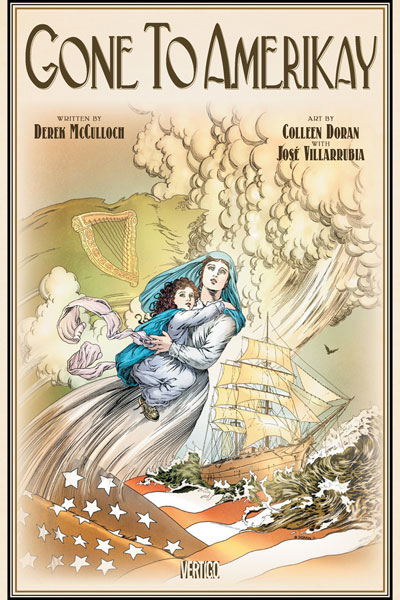
Last weekend, comics fans and creators gathered at the Harbor Lights Restaurant in New York City for the launch of Derek McCulloch and Colleen Doran’s new graphic novel Gone to Amerikay.

The star-studded party raised donations for CBLDF and several comics creators were in attendance, including McCullock, Doran, Paul Levitz, John Cassaday, Stuart Moore, and Jose Villarrubia, just to name a few. The Beat‘s Heidi McDonald and Torsten Adair also joined the party. Attendees had the chance to view original artwork, enjoyed drinks and hors d’oeurves, and picked up signed copies of the book.

Click through for a gallery of photos from the party…

EFF Protests Video Game Labeling Law

CBLDF and other free speech advocates won an important victory last year when the Supreme Court ruled in Brown v. EMA, striking down a California law that restricted the sale of video games to minors based on specious evidence that violence in video games causes violence in children. The law would have made violent speech a new category of unprotected speech, alongside obscenity.

A law proposed by Representatives Joe Baca and Frank Wolf has raised free speech concerns again. The Electronic Frontier Foundation has raised the issue.

More after the jump…

Tucson School Board Tightens Security

Imagine going through a security check more involved than anything you face before taking a flight, even if you’re a small child. You must be entering a high-security building, like the White House, right? You may also be entering a school board meeting in Tucson, Arizona.

The Tuscon Unified School District beefed up security at their school board meetings in response to the outrage fostered when the Tucson school district decided to end the Mexican American Studies program and removed several books by Mexican and Native authors from classrooms. Even small children are not exempt from being wanded and searched by security. When a Latino father took a photo of his 9-year-old son being searched before a meeting, his photo went viral and was embraced as emblematic of the anti-Latino and anti-immigrant attitude many feel is endemic in Arizona.

More after the jump…

In the Middle of an Uprising, Syrians Rediscover Satire

One of the side effects of the clashes and protests against President Bashar al-Assad that have seized Syria is the ability to speak more openly against the government, an ability that had been previously stifled by the regime. In the midst of this political discourse, some Syrians have embraced satire, generating videos, plays, and cartoons that use humor to counter the horror, frustration, and civil unrest that has affected citizens of the nation.

A recent report by Michael Rundle on the Huffington Post describes the role of satire in the protests, including the work of one cartoonist in particular, Ali Ferzat.

More after the jump….

Arizona Legislature Passes Sweeping Electronic Speech Censorship Bill

Yesterday, the Arizona legislature passed Arizona House Bill 2549, which would update the state’s telephone harassment law to apply to the Internet and other electronic communications. The bill is sweepingly broad, and would make it a crime to communicate via electronic means speech that is intended to “annoy,” “offend,” “harass” or “terrify,” as well as certain sexual speech. Because the bill is not limited to one-to-one communications, H.B. 2549 would apply to the Internet as a whole, thus criminalizing all manner of writing, cartoons, and other protected material the state finds offensive or annoying. The Bill is currently on Governor Jan Brewer’s desk awaiting her decision on whether to veto or sign the bill.

Media Coalition
, a trade association protecting the First Amendment rights of content industries, whose membership includes CBLDF, has been active in opposing the bill. On March 14, Media Coalition sent a memo to the Senate Rules Committee regarding constitutional infirmities in H.B. 2549. Yesterday they sent a letter to Governor Brewer urging her to veto the bill.

If passed, the law could create vulnerabilities for cartoonists and publishers who publish material online intended to shock, satirize, and criticize. Beyond the example of the Mohammad cartoons listed in the Media Coalition letter, the taboo-pushing work of cartoonists like R. Crumb, Johnny Ryan, and Ivan Brunetti would potentially be vulnerable to prosecution, as could incendiary works such as Frank Miller’s Holy Terror and Dave Sim’s Cerebus. Similarly, the culture of message boards, within and beyond comics, would be imperiled. With more titles released digitally each week, and an extremely active online ecosystem of professional and fan exchange, laws like this one are extremely worrisome for the creators, publishers, and readers of comics.